
Begin with the care labels you own
A small apartment does not need a large garment-care collection simply because the wardrobe contains several fabrics. Take a sample of the clothes you wear most and read their care labels. Note which can follow your normal wash routine, which need a different cycle or method, and which require professional care. The kit should respond to those instructions, not to an imagined wardrobe full of delicate garments.
Identify the actual difficulty. It might be nowhere to dry a knit flat, hangers that mark shoulders, or a lack of space to separate a load. Each problem calls for a different response. If laundry already works well, buying more care tools may add storage work without improving anything. Choose the smallest setup that makes the existing routine easier to complete.
Measure drying and storage space
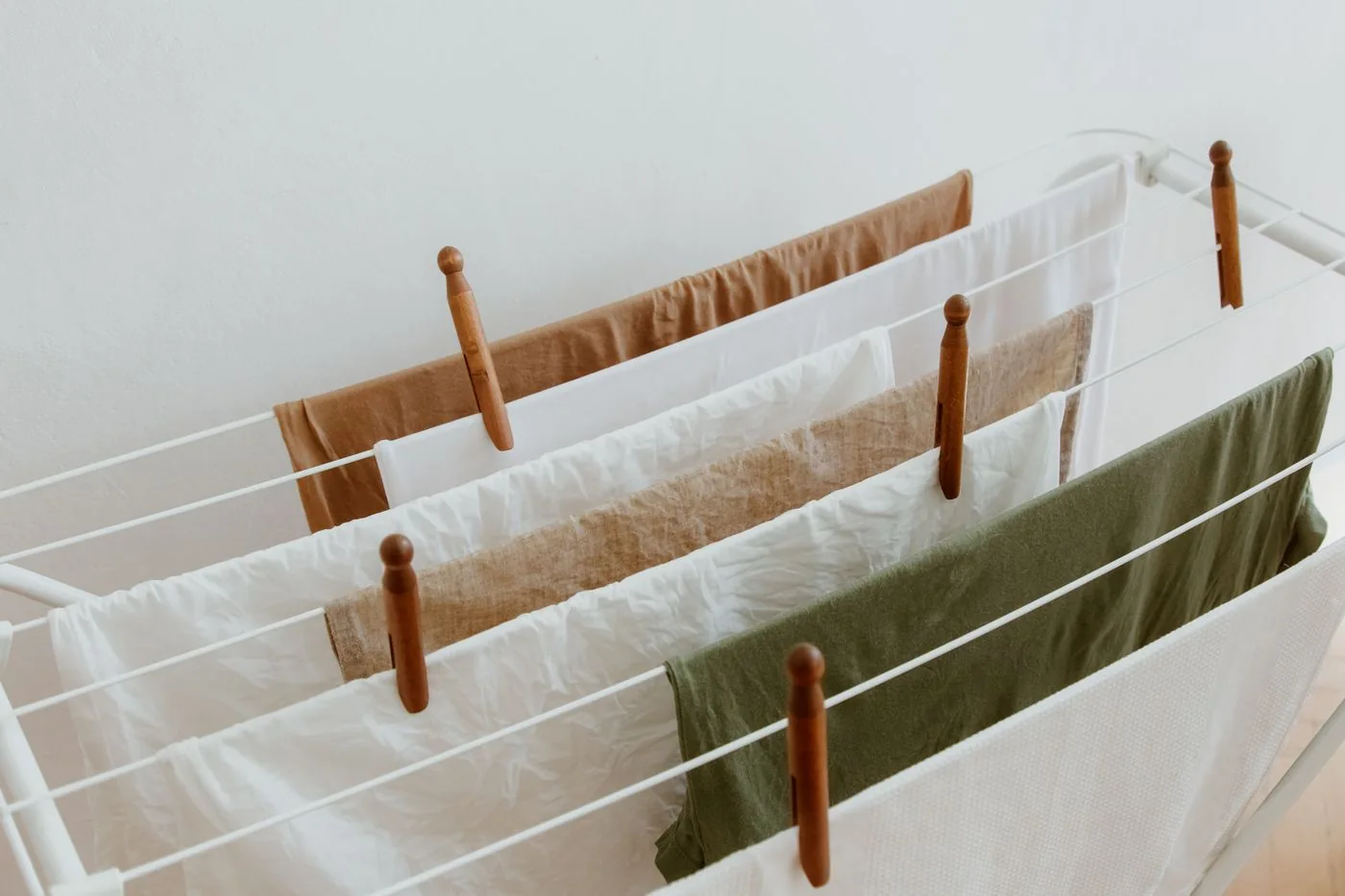
Before buying a drying rack, measure where it will be used and where it will live when folded. Allow space to move around it and consider how much laundry you typically dry at once. A compact product can still block a doorway when open. Look at the maker's listed dimensions rather than deciding from a photograph of a spacious room.
OXO's official folding sweater dryer uses a mesh surface to support garments lying flat. That makes it a candidate when your labels call for flat drying and your home lacks a suitable surface. It is not a promise that every sweater should be washed at home or that a rack makes unsuitable washing safe. Follow the garment's care instructions first, then select a tool that supports the required method. Check the rack's current dimensions and storage arrangement before ordering.
Match hangers to the garment
Hangers need to suit the item's construction and storage guidance. A tool useful for a shirt may not be appropriate for a heavy knit or a delicate piece. Inspect where the garment's weight is supported and whether a hanger leaves marks or stretches the shoulder shape. If an item should be folded, another set of hangers will not solve its storage problem.
MUJI's official laundry collection offers a range of drying and hanging accessories. Use it to compare the dimensions and intended use of specific items, not as a reason to buy the entire range. Start with the problem you observed, then choose a small number of suitable pieces. Uniform hangers can look tidy, but appearance is secondary to storing the garments appropriately. Mixed tools can be more useful than a matching set that treats every item the same way.
Keep care instructions ahead of generic tricks
Avoid applying a universal stain, heat, or washing method to unfamiliar fabric. Read the label and the product's instructions, test only where appropriate, and seek professional help when the item or stain requires it. An online care hack may omit the fabric, finish, or construction that determines whether it is safe. The cost of replacing a damaged garment can exceed the price of proper advice or cleaning.
A brush, steamer, or other tool is worth considering only if it has a clear role in your wardrobe and you can use it according to the instructions. Follow any appliance safety directions and fabric restrictions. Do not treat steaming as a replacement for every type of cleaning. If you would rarely use a tool, a suitable professional service may be more practical than storing another appliance in a small cupboard.
Make the routine easy to finish
Keep the frequently used items together in a modest container or designated shelf. Leave room for them to dry or cool as required before storage. Avoid a system that looks neat but demands you remove several other objects each time you need a hanger. A small care setup should make the ordinary wash day simpler rather than create a new organizing project.
After a few weeks, check which tools you actually used. Add another only when you can name the problem it solves. Follow each garment's own instructions and record unusual care needs if that helps you avoid mistakes. You may decide against buying a particular new fabric because its maintenance does not fit your space. That is a sensible shopping criterion. Clothing is more useful when you can care for it consistently, and a limited home can still support a thoughtful wardrobe without a large collection of equipment.
Choose one tool at a time
If flat drying is the problem, solve that before adding a steamer, brush, and several storage containers. Use the first tool through your normal laundry routine and see whether the space and setup work. A product that folds neatly but is inconvenient to open may not be the best answer for a small home. Check the storage arrangement as carefully as the advertised working surface.
What if the desired garment needs care your home cannot support? Include suitable professional care in the budget or choose a different garment. Buying a tool does not necessarily make the routine realistic. A large number of delicate pieces can create more work than a small apartment’s drying space comfortably handles. The most effective care kit may begin with clothing choices that suit your available time, space, and willingness to maintain them.
Options to consider
Use these retailer collections as starting points. Check the current product description, sizing, delivery and return terms before ordering; availability and prices can change.
Sources & further reading
Official information checked October 8, 2026. This guide presents research-based editorial advice, not a claim of hands-on product testing.
Illustrative stock photograph by Ron Lach: photo source. This scene does not identify our author or establish a product test.